12 Trading Lessons I Wish I Knew Before Starting (After 8 Years in Banks)
Quant Trading
After eight years in market finance at Lyxor, HSBC and Société Générale, here are the 12 trading lessons that separate gamblers from real investors: market efficiency, the true learning curve (8 to 10% a year within six months, 20% for the best hedge funds), edge decay, process versus result, beta versus alpha, sizing, multi-strategy, backtesting and automation. Plus a complete free training plan and book library.
Antoine
CEO - CodeMarketLabs
2026-10-09
There are endless ways to trade on the internet: technical analysis, fundamental analysis, quantitative analysis, and the list goes on. I'm not here to bash any of them. I'm here to give you the approach that, in my opinion, actually matters if you want to succeed in trading and in investing, after eight years on institutional desks. Below are the 12 lessons I'd want anyone to understand before putting a single euro at risk. And at the end, as a bonus, a complete free training plan with every book I personally read to learn trading and to get hired by the institutions I worked for.
What this article covers
Why market efficiency and the no-arbitrage principle should make you humble from day one.
The real learning curve: 8 to 10% a year within six months, then a very long road toward the 20% of the best hedge funds.
Why your edge always decays, why you must document it, and why trading is a research job.
Variance, process versus result, beta versus alpha, and the sizing mistakes that destroy good strategies.
Why multi-strategy beats single-strategy, how to read a backtest, and why you should automate as early as possible.
A free training plan and book library to go from beginner to professional level.
1. Who Is Giving You These Lessons
Before playing the lecturer, it seems fair to tell you where I come from. My name is Antoine, and from 2018 to 2026 I worked in market finance. I first studied at IAE Gustave Eiffel, then at Paris Dauphine University in mathematics and computer science. I started at Lyxor Asset Management in the middle office as a performance analyst, then joined HSBC as a junior trader on the money market desk, which manages the bank's balance sheet. I then spent four years at Société Générale as a portfolio manager on equities and derivatives based strategies. It was fun, and I learned an enormous amount.
That path is what allows me to be here today, in Panama, as a trader and investor managing my own capital. I will soon launch my own hedge fund, and I'll document the whole journey on the channel. In parallel, I founded CodeMarketLabs, my company, where I build software for fintechs, prop firms and any business that needs algorithmic trading, but also for individuals who want to automate their own strategies.
panama-city-skyline
2. Lesson 1: Market Efficiency and the No-Arbitrage Principle
Market efficiency simply means that the current price of a financial asset already reflects all available public information. That's it. The one thing to take away is humility: you cannot forecast next month's CPI or an NFP surprise better than everyone else. If you believe you can, you've already stepped into clown territory.
The no-arbitrage principle says that a risk-free gain never lasts. As soon as one is discovered, everyone piles in, takes all the money there is to take, and the opportunity vanishes. In practice, market prices are adjusted for everything everyone knows at time zero: NFP, CPI, earnings, and so on.
As Paul Samuelson showed in his 1965 paper, which I highly recommend, the most likely price tomorrow, given all the information available today, is today's price. You can even check it yourself: take the S&P 500 volatility surface, meaning all the option quotes, reverse engineer it to simulate the index one week ahead, and look at the implied probabilities. What the options market anticipates is clear: the most probable price is the current one.
3. Lesson 2: Learning to Trade Takes a Very Long Time
You will need to learn economics, financial markets, products, pricing and statistics. All of that takes time, and it is certainly not a fifty-hour online course. If that's what you think, you're still in Wonderland.
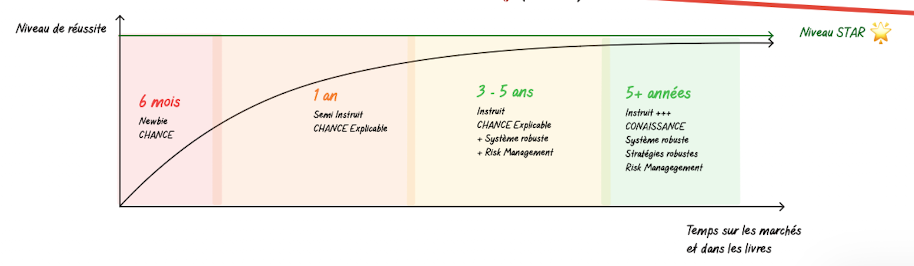
The good news is that progress is fast at the beginning. Within six months, you can already generate 8 to 10% a year with a solid ETF portfolio that you actually understand. That alone teaches you macro, central banks and what's really happening in markets, enough to build capital or a retirement. What's hard is everything after: the long climb toward the star level, which is almost unreachable. Just below it you find Citadel, Millennium or Man Group, the best hedge funds in the world, at roughly 20% annualized, about double an average investor in S&P 500 ETFs. Getting there requires infrastructure, quantitative, mathematical and technical skills, and very few people ever make it.
Is it worth it? Yes. 1,000 invested for 30 years at 8% becomes about 10,000. At 20%, it becomes about 237,000. Compounding makes the gap between an average investor and a professional enormous.
trading-learning-curve
4. Lesson 3: Markets Are a Permanent Competition
This is not open to everyone, because financial markets are a never-ending competition. What you are trying to build is an edge: a strategy that works because you have a comparative advantage. Either you are willing to carry a risk others don't want, or you found a price divergence between assets that others missed.
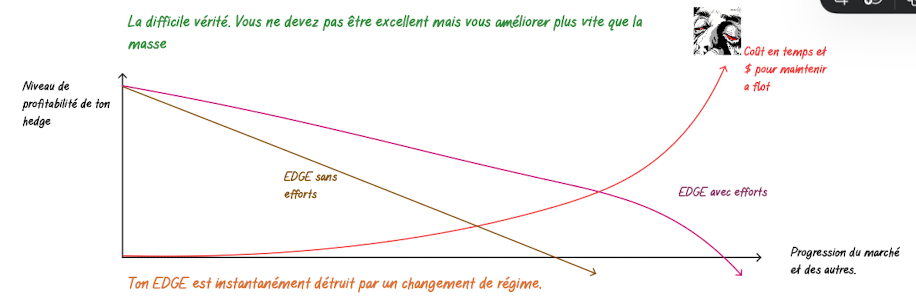
That edge is painful to find, and once you have it, it starts to disappear. The hard truth is that being excellent isn't enough: you must keep improving faster than everyone else. With zero effort, your edge drifts toward negative, because zero minus transaction costs is negative. With exponential effort in time and money, you can keep it afloat, but sooner or later it gets disrupted by a new technology, a better competitor, or someone who found the same thing on two other stocks.
Your edge also dies with market regimes. You were in a calm, low volatility regime, volatility suddenly explodes, and your edge is gone. Someone with a perfectly linear performance across every regime on a single strategy doesn't exist. Except Madoff, and we all know how that ended (the film about his story is excellent, by the way).
edge-decay-curve
5. Lesson 4: You Must Be Able to Document Your Edge
This one is non-negotiable. If you can't document your edge, throw it in the trash. It means you are trading luck. If you can't say why your strategy wins, which risk is being rewarded, and why you capture it rather than someone else, you don't belong in this industry. You're at the casino.
Documenting your edge is not paperwork. It's what lets you know whether a losing month is normal or whether the strategy is broken, and what lets you decide calmly when to keep going and when to stop.
6. Lesson 5: Trading Is a Research Job
Trading is not about enjoying fast, spectacular gains while doing nothing, with no skills and a ten-hour course. Do that and you will lose your money like someone betting on horses. It's about enjoying learning market finance and doing research. Success comes afterwards.
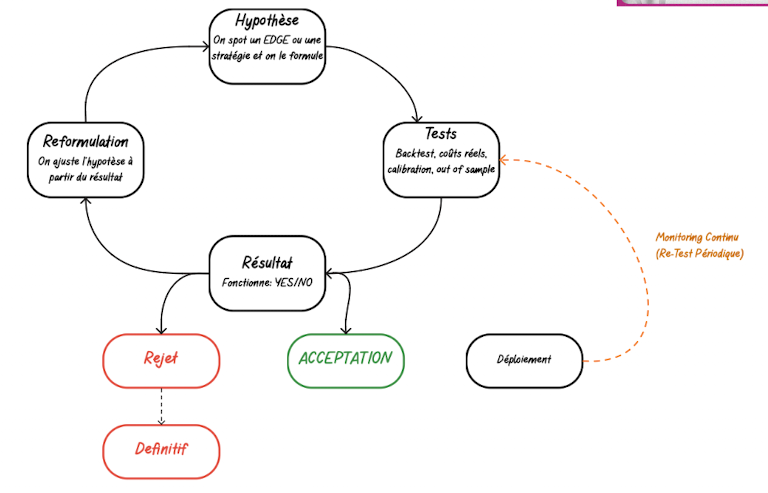
Concretely, that means running a proper loop: hypothesis, test, result, then acceptance or rejection. If the idea is rejected, you either reformulate it and test again, or you drop it for good. Every strategy you trade should have gone through that loop.
research-process-diagram
7. Lesson 6: There Is Always a Risk and Return Trade-Off
You have to put skin in the game. Trading pays you for risk: you get paid to carry a risk that someone else doesn't want to carry or doesn't have the technical means to carry. So every risk has a return.
Keep in mind that the bigger the risk, the harder the strategy will be to hold through drawdowns. Your job is to optimize it so it sits at the best level between return and risk. And once again, because of no-arbitrage, a strategy with no risk does not exist.
8. Lesson 7: Love the Process, Not the Result
This rule is crucial: love what you do. Why? Because every strategy has variance. Variance is the component that can make you lose money despite a good decision, and make you win despite a stupid one.
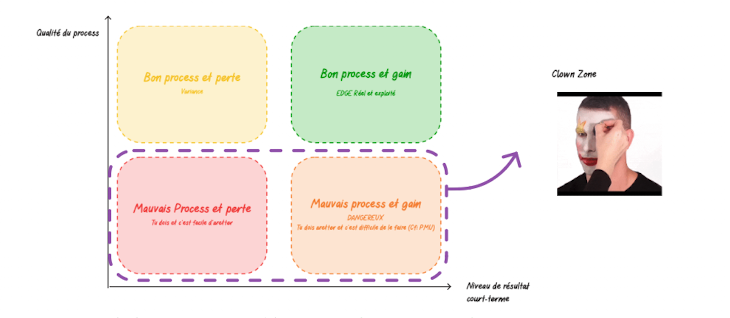
Picture a simple matrix. Good process and you lose: that can be the variance part, the share of the strategy where you are supposed to lose. It's verifiable and quantifiable, so you keep trusting your process. Good process and you win: great, your edge is real and well exploited. Bad process and you lose: you're at the casino, and at least it's easy to stop after three losses in a row. Bad process and you win: this is the most dangerous case, because you'll think you're a genius while you're just gambling and variance is carrying you.
Without a good process, you're in the wrong place. You want to sit with the people who do real research and have a real investment process, so you can be calm about what you do instead of questioning everything all the time. Have fun with the process first, and the results will follow.
process-vs-result-matrix
9. Lesson 8: Beta and Alpha, Your Two Performance Levers
Beta is your sensitivity to a risk factor documented in academic research: equities, bonds, momentum, value, growth and so on. You get paid because you carry that risk. Full stop. It's accessible to everyone.
Alpha is what remains of your portfolio's return once you remove the exposure to every known risk factor: what you really earn without being exposed to market risk. Ideally you want to outperform by generating alpha, since you add no extra exposure. In practice, most people outperform simply by increasing their beta: more leverage, better allocation across risk factors.
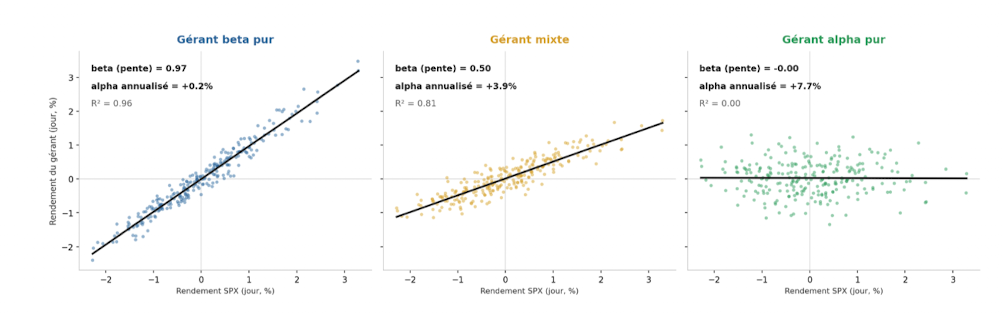
Personally, I don't claim to generate permanent alpha across many strategies. So I run strategies that are almost pure beta alongside strategies that are pure alpha, decorrelated from each other. Combined, that's the sweet spot. Visually, a pure beta strategy plotted against the market is a line with a slope close to 1. The lower the beta, the closer you get to 100% alpha, and the chart becomes a random cloud of points with no relation to the market.
beta-vs-alpha-regressions
10. Lesson 9: Sizing Comes Before Everything
A good edge cannot survive bad sizing. Over-leverage a good strategy and it will fail. Under-leverage a good strategy on a low volatility asset like bonds and it will fail too, because the performance will be pointless.
The tools to look at are the Kelly criterion and similar risk-adjusted indicators, which give you the optimal size for each strategy to maximize long-term wealth creation. On the S&P 500, the picture is striking: beyond a leverage of 2, you destroy value. At a leverage of 3, you actually lose wealth, because when a crash hits, you never recover.
To sum up the anatomy of a strategy: first the research to find the signal (when to buy, when to sell, what exposure, where the alpha comes from), then how you size, how you manage risk and how you execute.
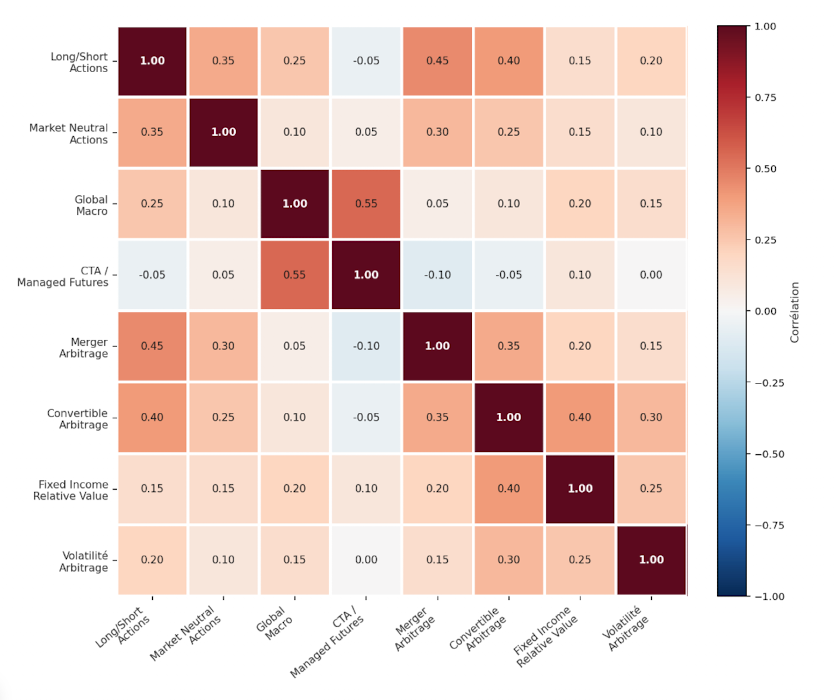
Once you have a strategy, an edge you can explain and an optimal size, the question becomes: one strategy or several? The answer is easy. Multi-strategy hedge funds that run many decorrelated strategies make roughly 15 to 20% a year. Take three strategies with a Sharpe ratio of 1 each, decorrelated: the portfolio's Sharpe will be above 1, because total volatility drops while the return stays the same.
Mathematically, the more decorrelated strategies you have, the better your Sharpe, and the more leverage you can take, since you're better rewarded for each unit of risk. On the other side you have pure single-strategy players, typically a global macro fund like Brevan Howard.
My personal analysis: single-strategy funds often become famous for one huge trade, shorting the subprimes or betting against the Bank of England. Once famous, they raise assets, and then not much happens. Meanwhile, quantitative multi-strategy funds keep cruising at 15 to 20% a year. My advice is to lean toward multi-strategy.
hedge-fund-strategy-correlation
12. Lesson 11: Backtest, but Distrust Beautiful Backtests
Everything above requires good backtests. If you don't backtest your strategy, you fall straight back into the retail trader category, and the statistics there are brutal: retail traders lose money most of the time. Why? Because those figures only include people playing the casino on CFDs, forex, intraday trading and futures day trading. People with no strategy, no edge, nothing documented, drawing lines on charts and convincing themselves that variance is performance when it's only luck.
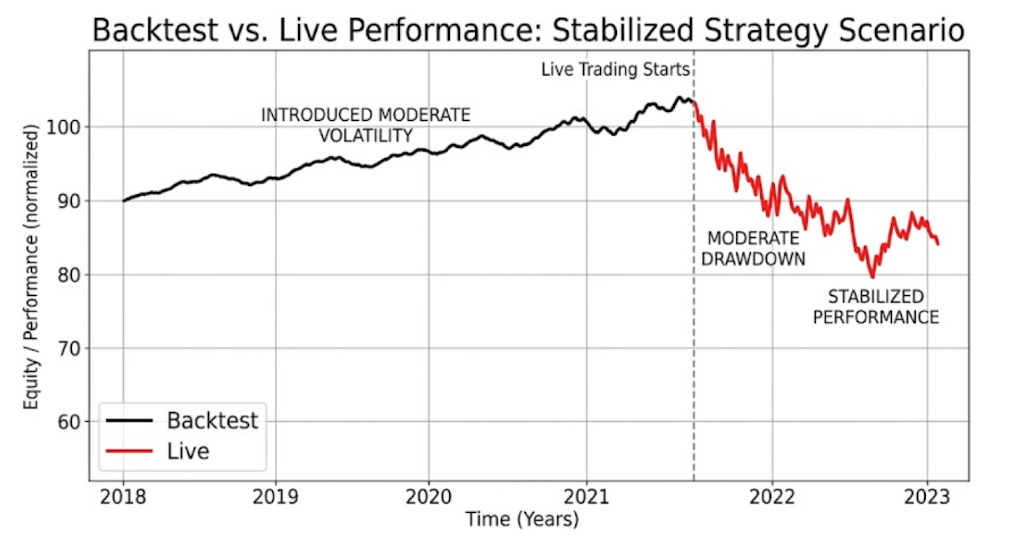
So backtest, because without it you only have an intuition. But be wary of backtests that look too good. A Sharpe of 5 and an almost linear equity curve usually mean overfitting, and once you go live, things won't happen as planned. In the backtest, you need to absolutely hammer your strategy: challenge it in every direction, change the parameters, check whether it still works on new data.
backtest-vs-live-overfitting
13. Lesson 12: Deploy, Organize and Automate
For me, this is the most important one. Every time you click a button to trade, you lose time, and that time isn't spent on research, which is where you actually make money. As I explained, whether most strategies are profitable or not depends on execution. If you hedge options and you're poorly delta hedged or vega hedged, the alpha your strategy generates shrinks. You can't do that by hand, so you have to automate it.
Trading manually also locks you into a single strategy, because nobody can run 50 strategies at once by hand. And automation forces you to systematize your strategies and make them bulletproof, compared to someone trading manually who gets it wrong half the time and never executes at the same level twice.
When should you do it? As soon as possible. It simplifies your whole infrastructure, and coding concepts makes complex mathematical and financial ideas click. Seeing a model run live in your own code often makes you understand problems usually reserved for experts.
14. Bonus: A Free Training Plan to Go Further
These 12 lessons are the tipping point between an amateur who gambles and someone with a genuine long-term investment strategy. It's exactly what I apply myself, using the technologies I build to turn a desk with 50 screens into algorithms running live.
I won't sell you a paid course. On the Discord linked to my channel, I share a complete trading training plan with every concept you need, a real learning path you can literally leverage with your favorite AI, plus the library of every book I read to become a market professional. It's entirely free. You can also ask me your questions there, or book a free call with me if you want to code your own algorithms.
Can I really make 8 to 10% a year after only six months of learning?
It's a realistic order of magnitude for a well diversified ETF portfolio that you understand, not a guarantee. Some years will be negative. The point is that the first level, understanding macro, central banks and a long-term portfolio, is reachable quickly, while going beyond that takes years.
What exactly is the difference between alpha and beta?
Beta is the return you get for carrying known risk factors such as equities, bonds, momentum or value, and anyone can access it. Alpha is what remains once all those exposures are removed. Most outperformance in practice comes from more or better managed beta, not from true alpha.
How much leverage should I use?
It depends on the strategy's return and volatility, which is why tools like the Kelly criterion exist. As an illustration, on the S&P 500, leverage above 2 tends to destroy long-term value, and around 3 a crash can wipe out the portfolio for good. Low volatility strategies can carry more leverage than equity strategies.
Why does a great backtest often fail once it goes live?
Usually because of overfitting: the parameters were tuned to past data rather than to a real, documented edge. A Sharpe of 5 or a near linear equity curve is a warning sign. Stress the strategy with parameter changes and out-of-sample data before trusting it.
Do I need to know how to code to start trading?
Not to start, since a well understood ETF portfolio doesn't require code. But to run several strategies, hedge properly and scale, automation becomes essential. Coding early also helps you truly understand the math behind the models.
Is the training plan really free?
Yes. The full training plan and the book library are available for free on the Discord linked to the channel. There is no paid course behind it.