If You Can't Price an Option, You're Getting Priced: How Banks Really Price Derivatives
Quant Trading
How a trading desk prices any derivative, from a simple call to an exotic structured product: no-arbitrage and replication, the risk-neutral probability, delta hedging, the volatility smile and the 5 steps used by the industry. Live example on the ES future: an exotic product priced with a calibrated Heston model and 50,000 Monte Carlo paths, worth 147.96$, without ever predicting the market's direction.
Antoine
CEO - CodeMarketLabs
2026-10-30
A bank offers you a product: 2,500$ if the S&P 500 future hits a new 30-day high on three observation dates, plus a 500$ bonus if volatility goes above 25% at least once. It gives you a price. And that price was computed without the slightest idea of whether the market will go up or down over the period. That is not a mistake, it is the very principle of derivatives pricing. I spent years on trading desks at Société Générale and HSBC, and in this article I walk you through exactly how a desk prices any derivative, from a simple call to an exotic structured product, with five principles, real numbers, and a live pricing of that product on the ES future.
What this article covers
Why not knowing how to price means you get priced: overpriced retail products and structured notes.
No-arbitrage and replication: pricing a call with two equations and finding the risk-neutral probability Q.
Why delta hedging makes the price independent of the market's direction, shown on 1,000 simulated scenarios.
The volatility smile, skew and surface on the ES, and why Black-Scholes is wrong.
The 5 steps every desk follows: payoff, model, calibration, simulation, discounting.
Live pricing of an exotic product with a calibrated Heston model and 50,000 Monte Carlo paths: 147.96$.
1. If You Can't Price, You Get Priced
Why bother learning derivatives pricing? Because if you trade options or derivatives without knowing how to price them, you are the one being priced. The retail market is full of products like turbos, warrants and autocallables. Many of them are sold far above their fair value, and not by a small margin: that is precisely where banks and investment firms make money at your expense. In derivatives, if you overpay at the start, you have almost no chance of making a profit at the end, even if your market view turns out to be right.
Second point: a structured product such as "capital guaranteed if the CAC 40 does not fall more than 30% this year" is usually nothing more than a bond plus a combination of a few options. Once you understand the principles, you can often build that same asymmetric profile directly in your own portfolio, without paying the margins of the bank that structures it, the one that distributes it and the advisor who sells it to you.
Third point: the price of an option is the price of risk. From option prices across every maturity and every strike, you can extract the implied probabilities of what the market expects for the S&P 500 or any stock. Most people never look at this information. In short, knowing how to price derivatives means you stop financing an industry and start working for yourself.
2. No-Arbitrage and Replication: Pricing a Call With Two Equations
The founding principle is simple: if a portfolio of assets exactly reproduces the payoff of a derivative at maturity, both must have the same price today. Otherwise you would buy one, sell the other and pocket a risk-free profit. Arbitrage does not survive on financial markets, or not for long.
Take a stock worth 100 today. Tomorrow it will be worth either 110 or 90, and we do not know which. I want to sell a call with a strike of 100 expiring tomorrow, so I will have to deliver 10 if the stock goes up and 0 if it goes down. To replicate that payoff, I build a portfolio of delta shares plus an amount B of cash, borrowed or lent. In the up scenario: 110 delta + B = 10. In the down scenario: 90 delta + B = 0.
Two equations, two unknowns. The second gives B = -90 delta. Substituting into the first gives 20 delta = 10, so delta = 0.5 and B = -45. To replicate the call, I borrow 45, buy half a share at 100, and the strategy costs 50 - 45 = 5$. With no arbitrage, 5$ is the price of the call.
Now weight each outcome by 0.5: 0.5 x 10 + 0.5 x 0 = 5, the price of the call. And 0.5 x 110 + 0.5 x 90 = 100, the price of the stock today. That 0.5 is not the real probability that the stock goes up. It is simply the number that turns any price into a weighted average of future outcomes. In financial mathematics, it is called Q, the risk-neutral probability.
3. The Risk-Neutral World
What we just did is not a trick specific to this example. It is a theorem. If there is no arbitrage, then there exists a probability Q under which the discounted price of any asset is a martingale. In plain terms, the current price of a financial asset is nothing more than the expectation under Q of its future payoffs, discounted at the risk-free rate: V0 = e^(-rT) x E^Q[payoff].
In my example I borrowed for free, but in reality there is always a risk-free rate to discount with. This single line is the foundation of the entire derivatives pricing industry. Everything else is about computing that expected payoff correctly, which is exactly what we do at the end of this article.
4. Why It Works: Delta Hedging
In the one-period example, delta was 0.5, so I just had to buy half a share. In real life, delta changes every day, every hour, every second. As an option seller, replicating the call means continuously adjusting your position to hold exactly delta units of the underlying. That is delta hedging.
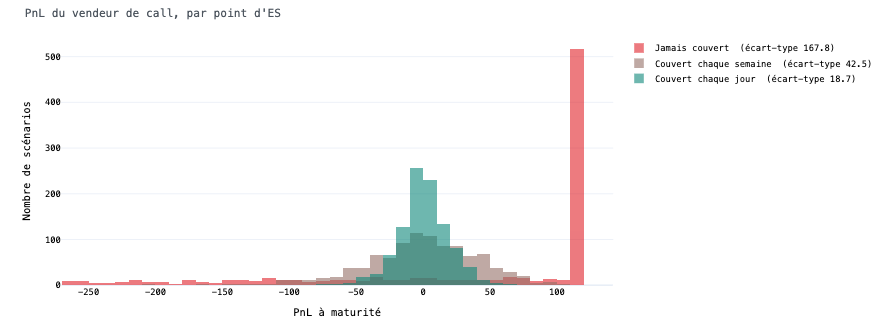
PnL d'un vendeur de call sur 1 000 scénarios simulés : non couvert (écart-type 167,8), couvert chaque semaine (42,5) et chaque jour (18,7). Plus on rebalance, plus le risque disparaît.
The simulation makes it concrete. Unhedged, the call seller either keeps the full premium (about half the scenarios, the tall bar on the right) or takes potentially unlimited losses when the market rallies. Hedging weekly brings the standard deviation of the PnL from 167.8 down to 42.5 points, and hedging daily brings it to 18.7. The more frequent the rebalancing, the more market risk disappears, and a riskless position can only earn one thing: the risk-free rate. Otherwise there would be an arbitrage.
The key takeaway: the price of a derivative never depends on the direction of the underlying. It depends on the expected payoff, which itself depends on volatility and the risk-free rate. In our example, the real probability of the market going up or down was never used. Derivatives pricing desks simply do not care about it.
5. Smile, Skew and the Black-Scholes Lie
In our example, a single Q was enough because there were only two outcomes and one horizon. In reality, the market has thousands of possible prices for tomorrow, and it does not price every option with the same volatility. There is a continuum of implied volatilities across strikes and maturities.
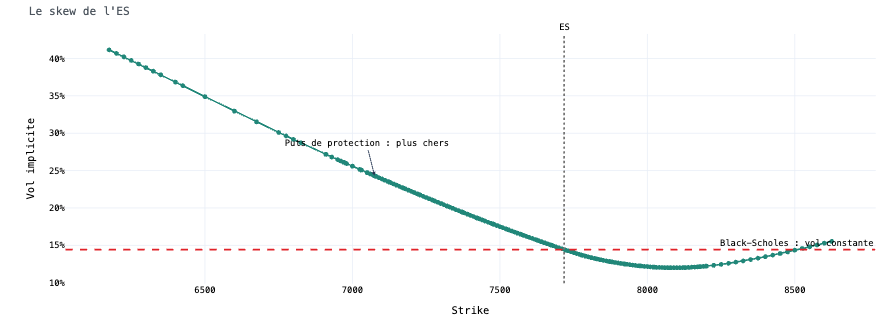
Skew de volatilité de l'ES : les puts hors de la monnaie se traitent à une vol implicite bien plus élevée que la vol constante de Black-Scholes. Le marché paie pour se protéger du krach.
On equity indices, out-of-the-money puts are much more expensive than a constant volatility model would suggest, because the market anticipates crash risk and demands more to insure you against it. This is the volatility smile, or skew on equities. Most of the models that give you option prices ignore it, starting with Black-Scholes, which assumes a single constant volatility.
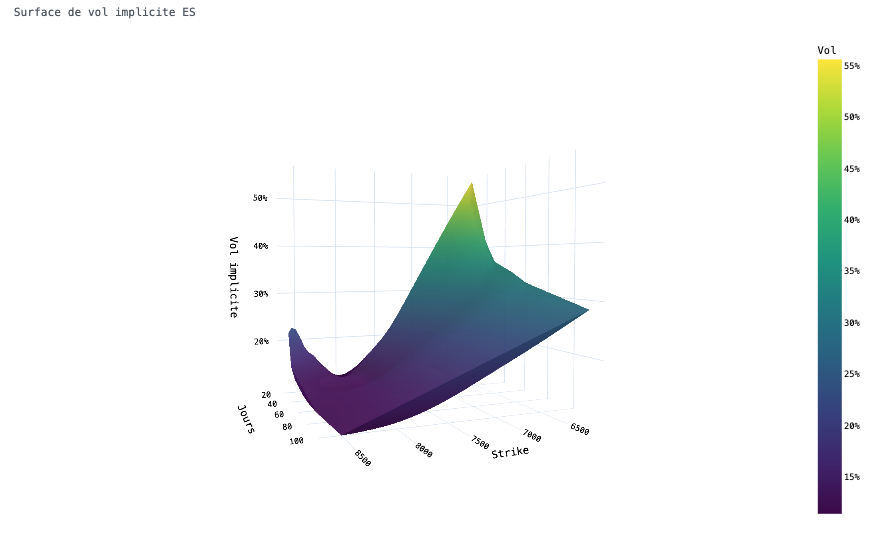
Surface de volatilité implicite de l'ES par strike et maturité : le prix du risque sur chaque strike et chaque horizon, utilisée pour calibrer les modèles de pricing.
One smile per maturity makes a surface. This volatility surface represents the risk priced by option buyers and sellers for every maturity, every strike and every underlying, and it is where you can read the market's implied probabilities for the coming weeks. In practice, before modeling any complex derivative, you need a model rich enough to reproduce the price of every listed option on that surface.
6. How the Industry Actually Prices: The 5 Steps
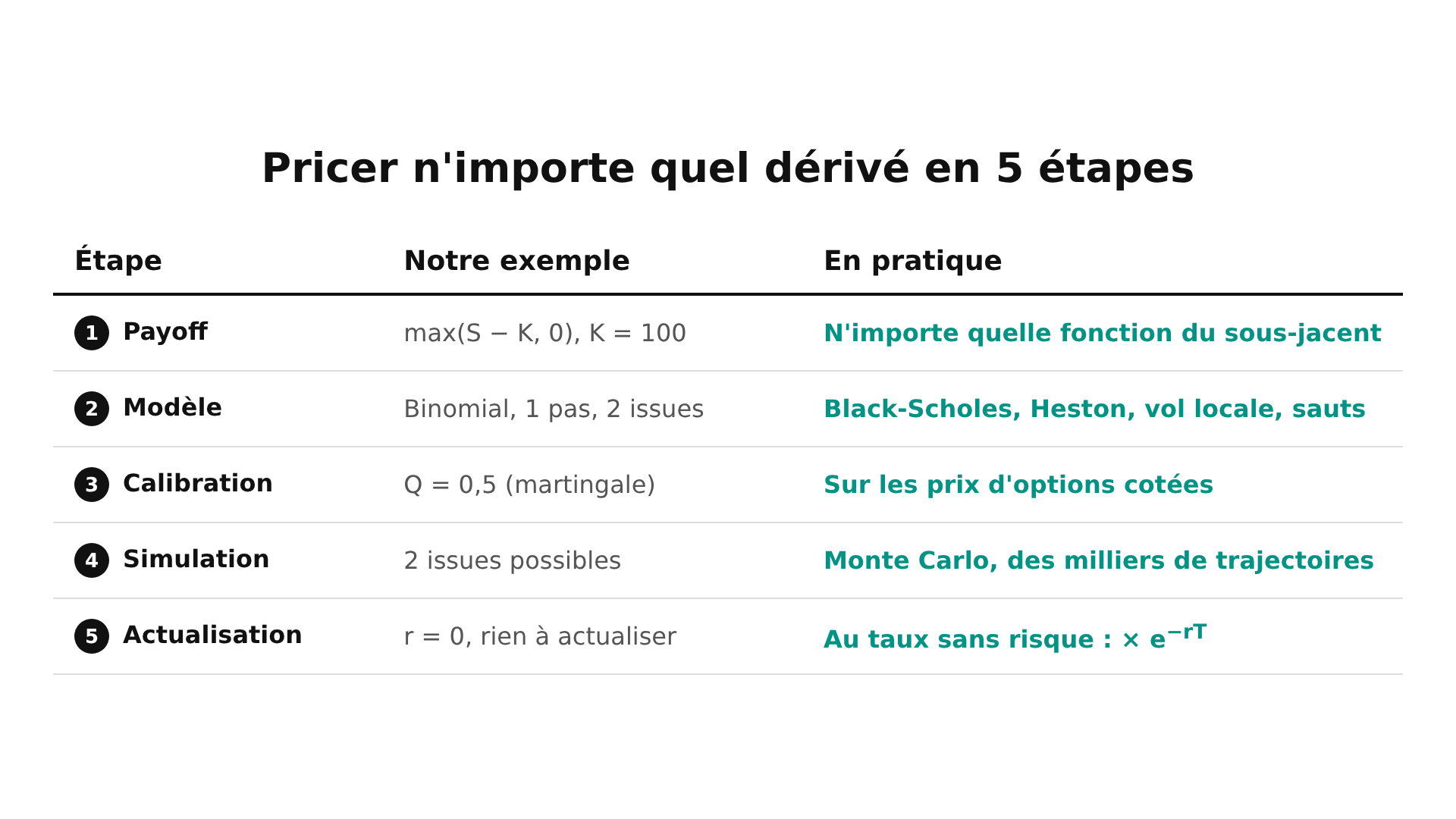
Les 5 étapes pour pricer n'importe quel dérivé : payoff, modèle, calibration, simulation et actualisation, de notre exemple binomial à la pratique réelle.
Step 1, the payoff: what do you want in the future? Earn 10% if the S&P rises or falls by X, a capital guarantee, a fixed coupon. In our example it was max(S - K, 0). In practice, it can be any function of the underlying. Step 2, the model: in our example, a one-step binomial tree with two paths. In reality there are thousands of paths, and you need a model that reproduces them: Black-Scholes, Heston, Merton, models with probabilistic jumps. The right model differs depending on whether you are on the S&P 500, Treasury bonds or Bitcoin.
Step 3, calibration: in our example Q = 0.5, which was very simplistic. In practice, you collect the prices of all listed options on the underlying and fit the model parameters so that it reproduces what the market thinks. Step 4, simulation: you generate thousands of possible future paths, the Monte Carlo method, and apply the payoff function to each one. Step 5, discounting: you discount the average payoff at the risk-free rate, which gives you the price of your derivative or structured product.
The great thing about these simulations is that they serve far more than pricing. As an options trader, I use the same paths to compute the Value at Risk of my options book, my potential loss over a given horizon, and to run stress tests: how much does my portfolio lose in this or that scenario. That is what lets you trade with confidence.
7. Live Pricing: An Exotic Product on the ES Future
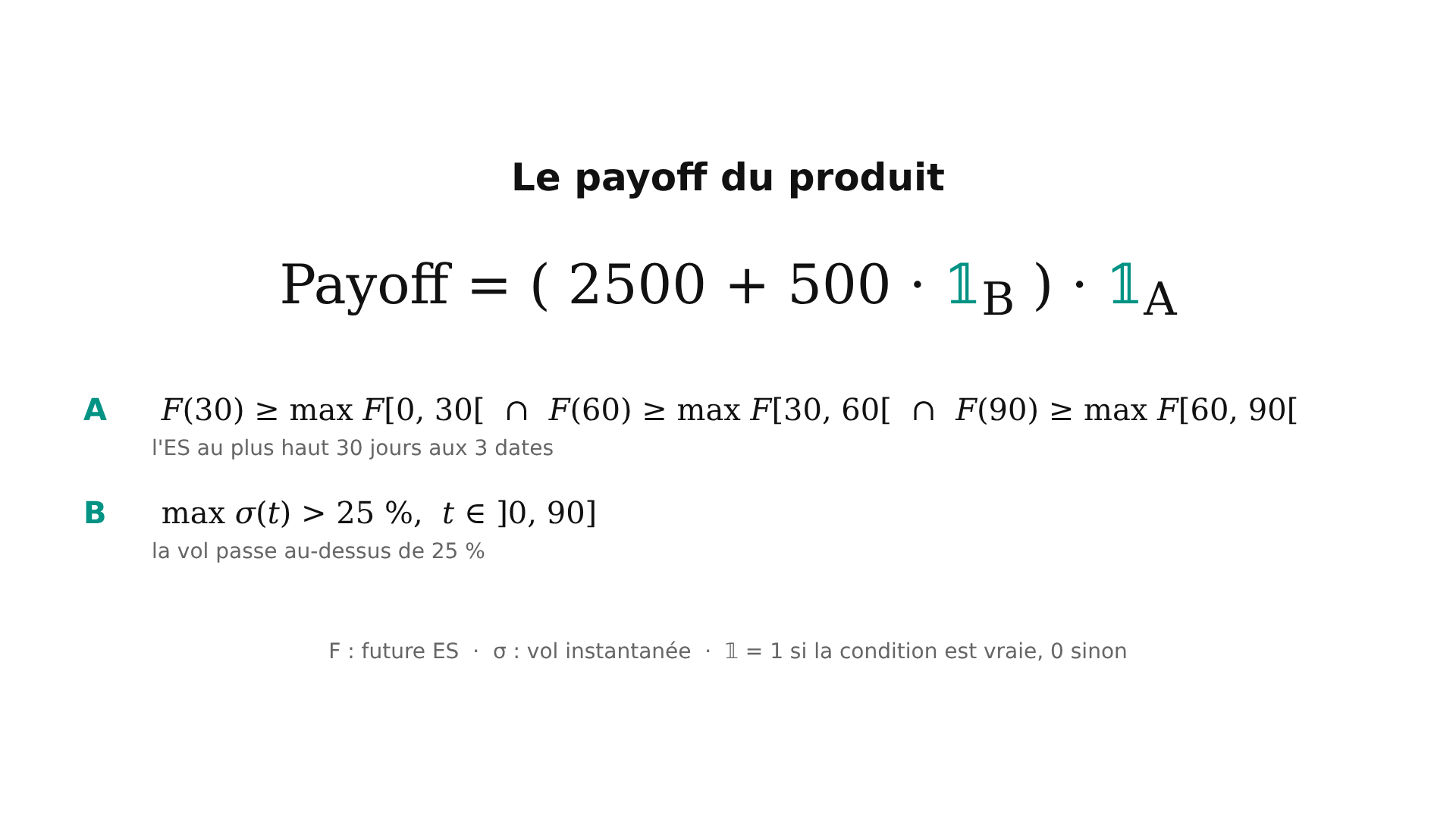
Let us apply all of this to the product from the introduction. First, translate it into a precise payoff: on each of three observation dates (day 30, day 60 and day 90), check whether the S&P 500 future is above its highest level of the previous 30 days. If yes on all three, you receive 2,500$. If on top of that volatility went above 25% during the period, you receive 500$ more.
Payoff du produit exotique : 2 500$ si le future ES est à son plus haut 30 jours aux 3 dates d'observation, plus 500$ si la volatilité dépasse 25% entre-temps.
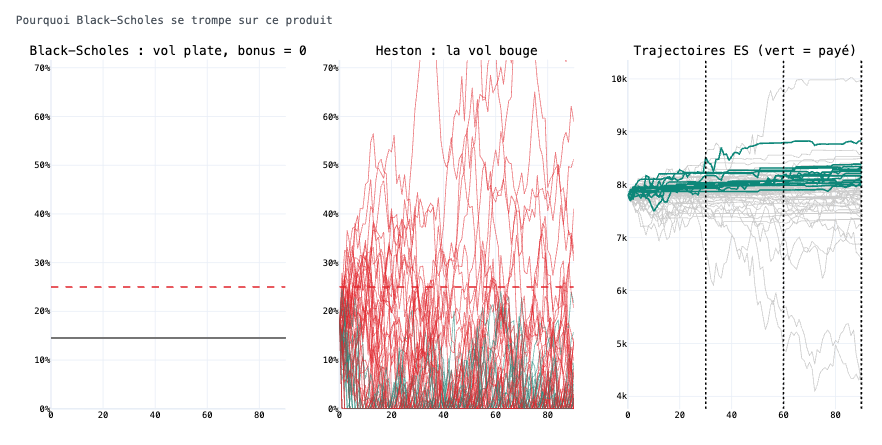
Here comes the first trap. With Black-Scholes, volatility is constant, so it never crosses 25% and the 500$ bonus is worth exactly zero. The model tells you that part of the product is free, which is wrong, and the whole price is off. To price this product, I need a model in which both the price and the volatility move. So I use a Heston model, where volatility is itself random and negatively correlated with the market.
Pourquoi Black-Scholes se trompe sur ce produit : sa vol reste plate sous 25%, donc le bonus vaut zéro, alors que la vol de Heston la dépasse régulièrement. À droite : les trajectoires ES qui paient, en vert.
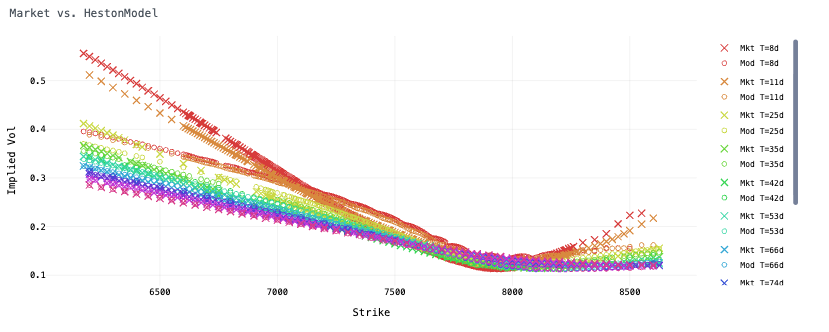
To calibrate it, I pull every option on the S&P 500 volatility surface for the coming months and reverse-engineer the model parameters. The result: the calibrated Heston model matches market option prices almost perfectly and captures the full asymmetry of the skew.
Calibration du modèle de Heston sur la surface de vol de l'ES : vols implicites du marché (croix) vs vols du modèle (cercles) pour chaque maturité.
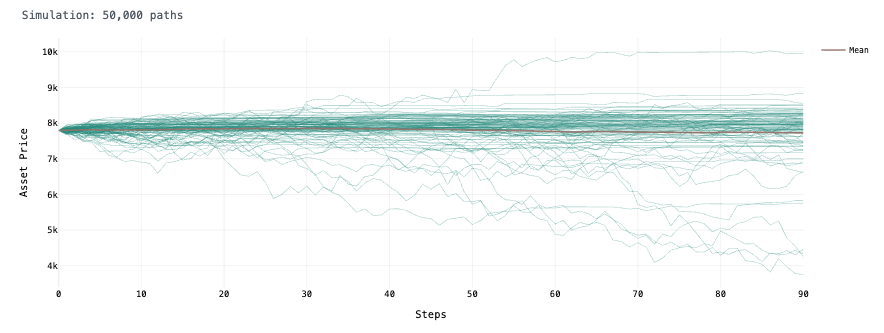
Step four, the simulation: I generate 50,000 paths of the S&P 500 future with the calibrated model. On each path, I apply the rule of our structured product, then average and discount at the risk-free rate.
50 000 trajectoires Monte Carlo du future ES sur 90 jours sous la probabilité risque neutre, simulées avec le modèle de Heston calibré.
The result: this structured product is worth 147.96$. And once again, to give you that price, I never needed to know whether the S&P 500 would go up or down over the coming months.
8. From Theory to Your Own Trades
Remember the starting point: if you cannot price a product, you get priced. Before buying options or derivatives, you need a complete process to know the fair price of what you are buying and the probability attached to that price.
Between understanding the theoretical process in this article and applying it to a real decision, a warrant you are looking at on your broker or a structured product your banker is offering you, there is a gap, and there are often specific questions that a YouTube video cannot answer. If you are building an options strategy for the year ahead or considering a structured product and want help modeling it and checking whether it fits your needs, you can book a coaching call with me and we will go through all your derivatives questions.
Is the risk-neutral probability Q the real probability that the market goes up?
No. Q is the probability that makes the discounted price of every asset a martingale, so that any price can be written as a discounted average of future payoffs. It reflects the cost of hedging, not a forecast. The real-world probability of the market rising is never used in pricing.
Why can't I just use Black-Scholes to price options?
Black-Scholes assumes a single constant volatility, while the market prices each strike and maturity with a different implied volatility (the smile and skew). It works as a quoting convention, but for any product that depends on the shape of the distribution or on volatility itself, like the exotic in this article, it gives a wrong price.
Does delta hedging remove all the risk in practice?
Not entirely. Perfect hedging requires continuous rebalancing with no costs. In practice you rebalance at discrete intervals and pay transaction costs, so some residual risk remains (in our simulation, a standard deviation of 18.7 points with daily hedging). Jumps and volatility changes also create risks that delta alone does not cover.
Can I really replicate a bank's structured product myself?
Often, yes. Many structured products are a zero-coupon bond plus a combination of options. With access to listed options and an understanding of pricing, you can build a similar asymmetric profile and avoid the structuring and distribution margins. Some features, like specific barriers or long maturities, may be harder to reproduce with listed instruments.
Why use Heston rather than another model for the exotic product?
The product pays a bonus when volatility crosses 25%, so the model must let volatility move on its own. Heston models volatility as a random, mean-reverting process negatively correlated with the price, which reproduces the equity skew. Once calibrated on the ES surface, it fits listed option prices closely and gives a realistic value to the volatility bonus.