Futures vs Options: Which One Should You Actually Trade?
Quant Trading
A practical breakdown of futures vs options by a former Société Générale and HSBC trader: obligation vs right, linear vs convex payoff, margin and margin calls, how each is priced, theta decay (an at-the-money call losing 39% of its value in the last 10 days), when to use each instrument, and the hidden costs of roll, vol crush and option spreads.
Antoine
CEO - CodeMarketLabs
2026-11-23
Most people who start trading derivatives go straight to options, not futures. The reasoning sounds solid: with an option, your loss is capped at the premium, so it must be safer. That is not always true, and more importantly, options are often not the right tool for what you are actually trying to do. I trade both every day, for my own book and before that in institutions, and I use them for very different jobs. In this article I break down how each one makes and loses money, and exactly when I pick one over the other.
What this article covers
Why a future is an obligation and an option is a right, and what that does to your P&L.
How margin, mark to market and margin calls work on futures, and why selling an option puts you in the same seat.
How a future is priced (spot plus cost of carry, the basis) and why an option depends on far more variables.
Theta in practice: an at-the-money call losing 39% of its value in the last 10 days with the underlying flat.
When to use futures (direction, hedging, trend following, spreads) and when to use options (convexity, volatility, premium capture).
The hidden costs: futures roll, contango, vol crush, wide spreads, and why options are much harder to backtest.
1. Obligation vs Right: The Core Difference
A future is a forward contract traded on an exchange. You agree today on a price for an asset at a future date. If you are long a future, you are committed to buy the asset at the price you traded. You and your counterparty are tied together, and the exchange clearing house sits in the middle. Your only way out is to close the position by trading the opposite side.
An option is a right, not an obligation. If you buy a call, you pay a premium for the right to buy the asset at a given strike, at a given date. At expiry you choose whether or not to exercise. That optionality is exactly what you are paying for.
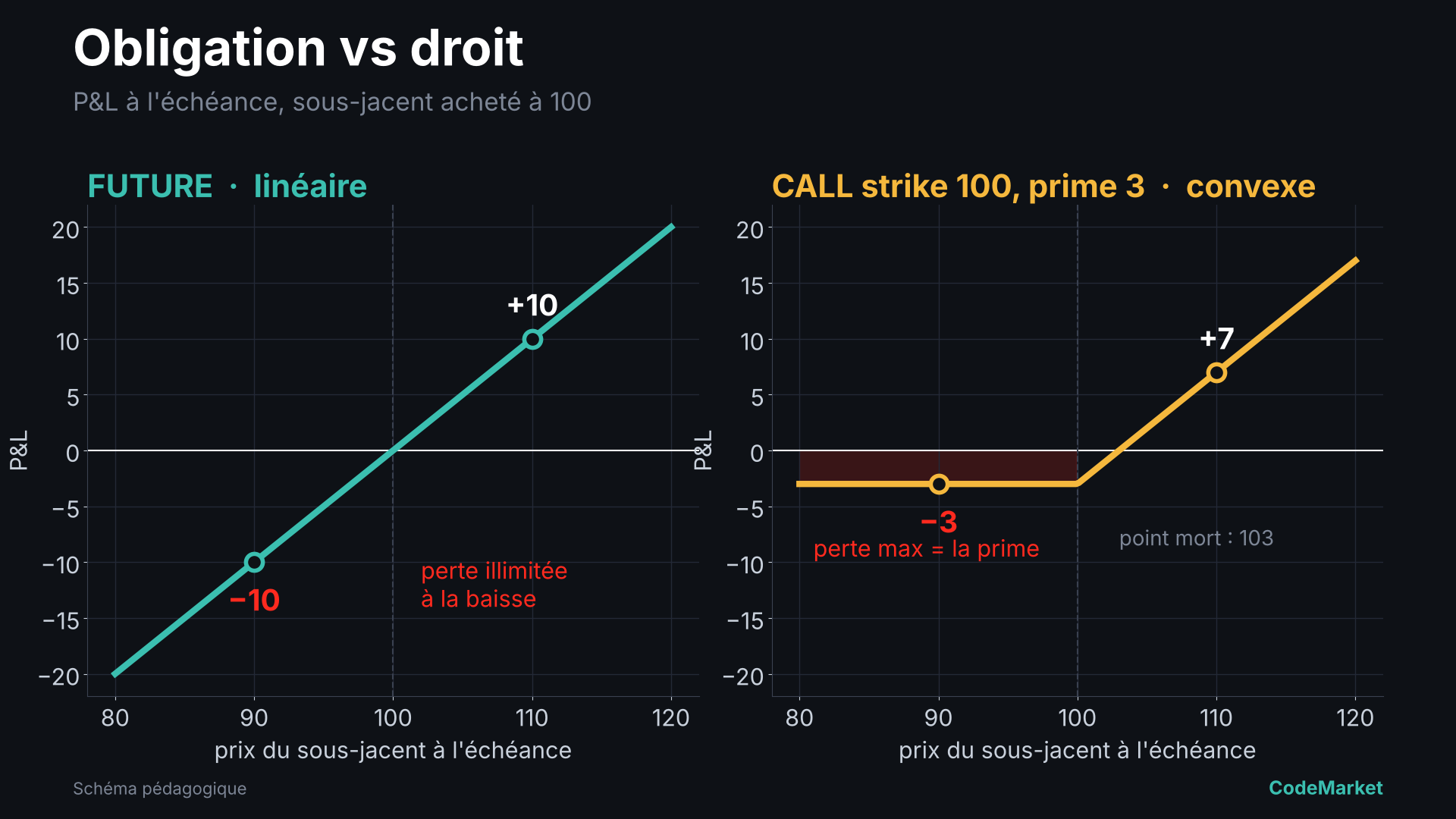
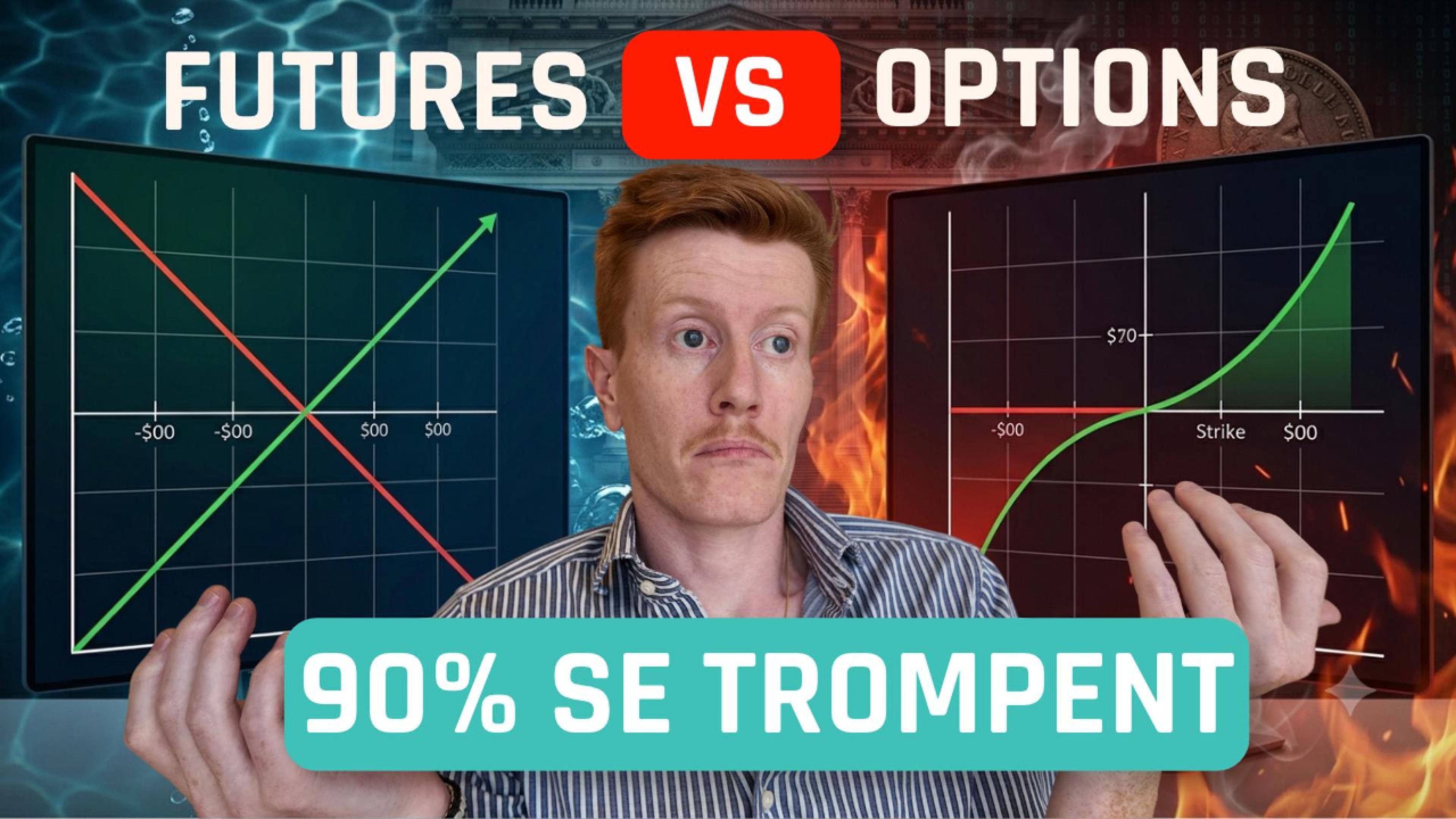
Take a stock at 100. Buy a future at 100: if the stock goes to 110 you make 10, if it drops to 90 you lose 10. The P&L is perfectly linear, which is why futures are called delta one products. Now buy a call with a strike of 100 for a premium of 3: at 110 you make 7 (10 minus the premium), at 90 you only lose the 3. The option's P&L is convex, and you pay for that convexity on every trade, even when you are right.
Payoff à l'échéance d'un future contre une option : payoff linéaire du future (+10 / -10) face au payoff convexe d'un call strike 100 avec une prime de 3 (+7 / -3, point mort à 103).
2. Margin, Mark to Market and Margin Calls
The second difference is how much capital you actually commit, and this is where a lot of people get burned by leverage. When you buy a future, you do not pay for the contract. You post margin. At Interactive Brokers, the broker I use every day, that is typically in the region of 10% of the contract value, depending on the product.
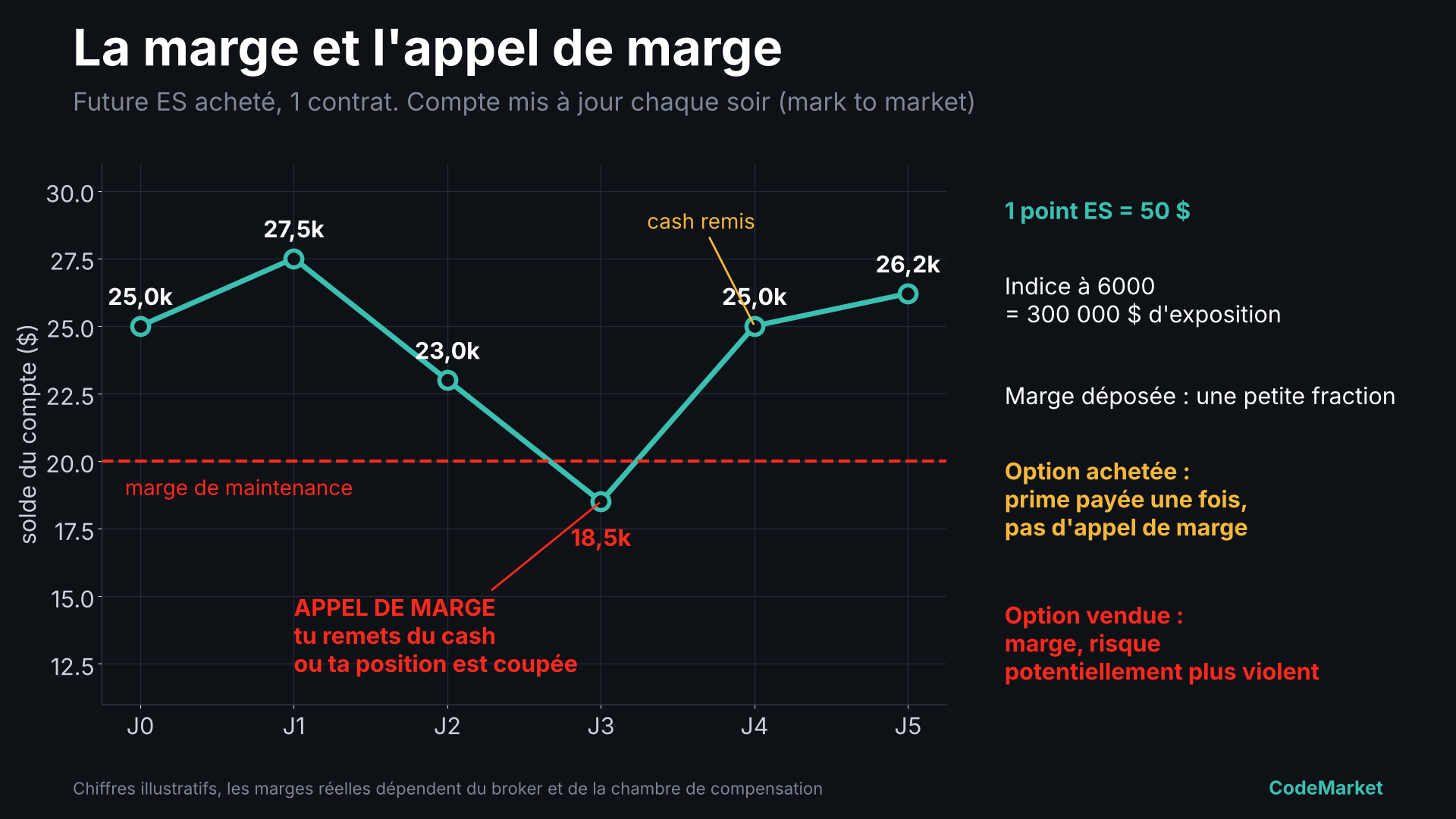
The contract then moves up and down. Every evening the clearing house settles the difference: if the future moved against you, cash is taken from your account to guarantee you can honor the contract; if it moved in your favor, you receive cash. That daily settlement is your mark to market P&L. If the position keeps going against you and your account falls below the maintenance margin, your broker issues a margin call. You add cash, or the position is liquidated.
Comment fonctionne la marge sur les futures : mark to market quotidien sur un contrat future ES, marge de maintenance et appel de marge, comparés à l'achat d'option (prime payée une fois) et à la vente d'option (marge exigée).
Buying an option works differently. The premium leaves your account once, upfront. Either you sell the option back higher and get more cash back, or it expires worthless and the cash never comes back. Selling an option is another story. It requires enough capital and specific trading permissions (at IBKR there are short tests to pass), and once you sell, you are in the same position as a futures trader: you collected a small premium, but if the market moves against you, you owe the difference and you face margin calls. So options are less risky only when you buy them. Sold, they can be riskier than a future.
3. How a Future Is Priced: Carry and Basis
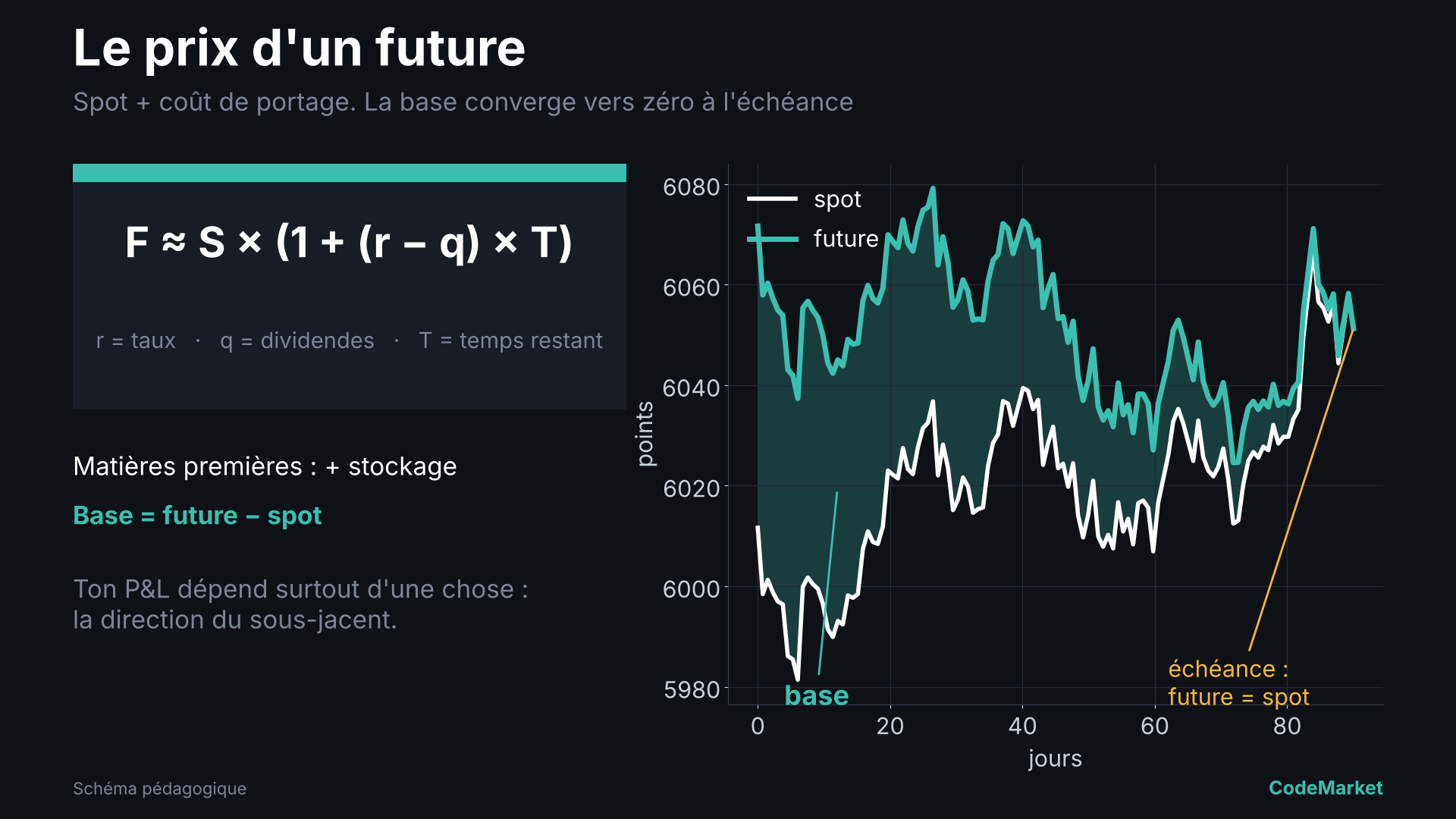
Pricing a future is simple. It is today's spot price plus the cost of carry. For an equity index, the carry depends on the risk-free rate and the dividend yield. If rates and dividends are at the same level, there is no carry and the future trades at spot. If dividends are higher than rates, the future trades below spot; if rates are higher than dividends, it trades above spot.
The gap between the future and the spot is called the basis, and it always converges toward zero. The closer you get to expiry, the smaller the carry, until future and spot meet on the last day. Bottom line: a future is a delta one product, and your P&L depends almost entirely on the move in the underlying.
Le prix d'un future expliqué : le future vaut le spot plus le coût de portage (taux moins dividendes), et la base entre future et spot converge vers zéro à l'échéance.
4. How an Option Is Priced: Theta and Volatility
Option pricing is far more complex (I have a dedicated video on it). The price of an option depends on the spot, the implied volatility, interest rates, dividends and the time left to maturity. The Greeks measure those sensitivities: delta for the underlying, gamma for how fast delta changes, vega for volatility and theta for time.
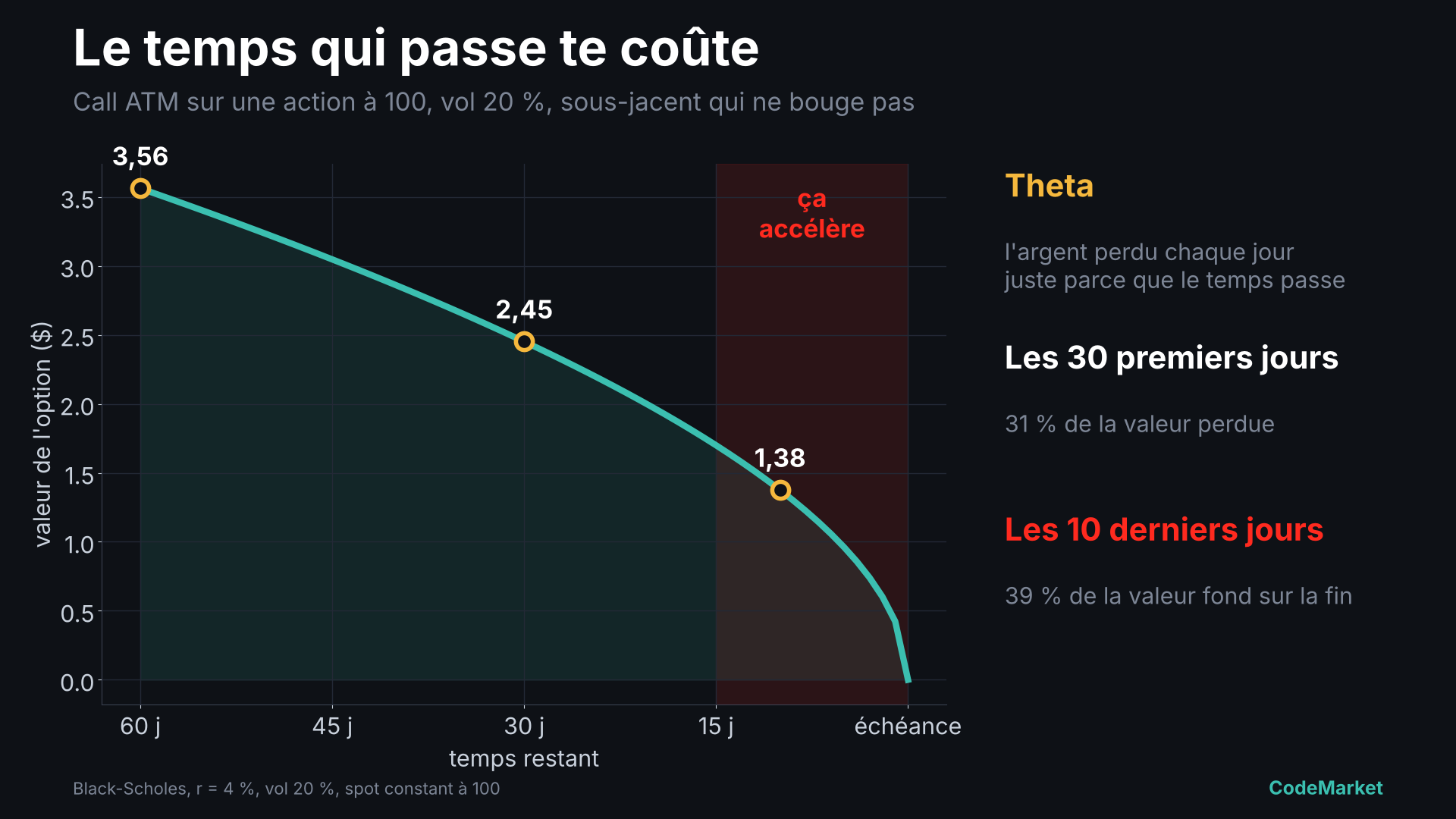
Time works against the option buyer. In the example below, the underlying never moves and the at-the-money call loses value every single day. Over the last 10 days, it loses 39% of its initial value. That is why you can be right on direction and still lose money with an option: if the move comes too late, or is too small, theta eats your edge.
Le theta d'une option : valeur d'un call à la monnaie avec 20 % de volatilité qui perd de la valeur chaque jour à sous-jacent constant, et une érosion qui accélère sur les 10 derniers jours avant l'échéance.
Volatility adds a second trap. You can be right on direction but wrong on future volatility or rates, and the option still loses value. With a future, none of this exists: the only variable that matters is the move in the underlying.
5. When to Use Futures, When to Use Options
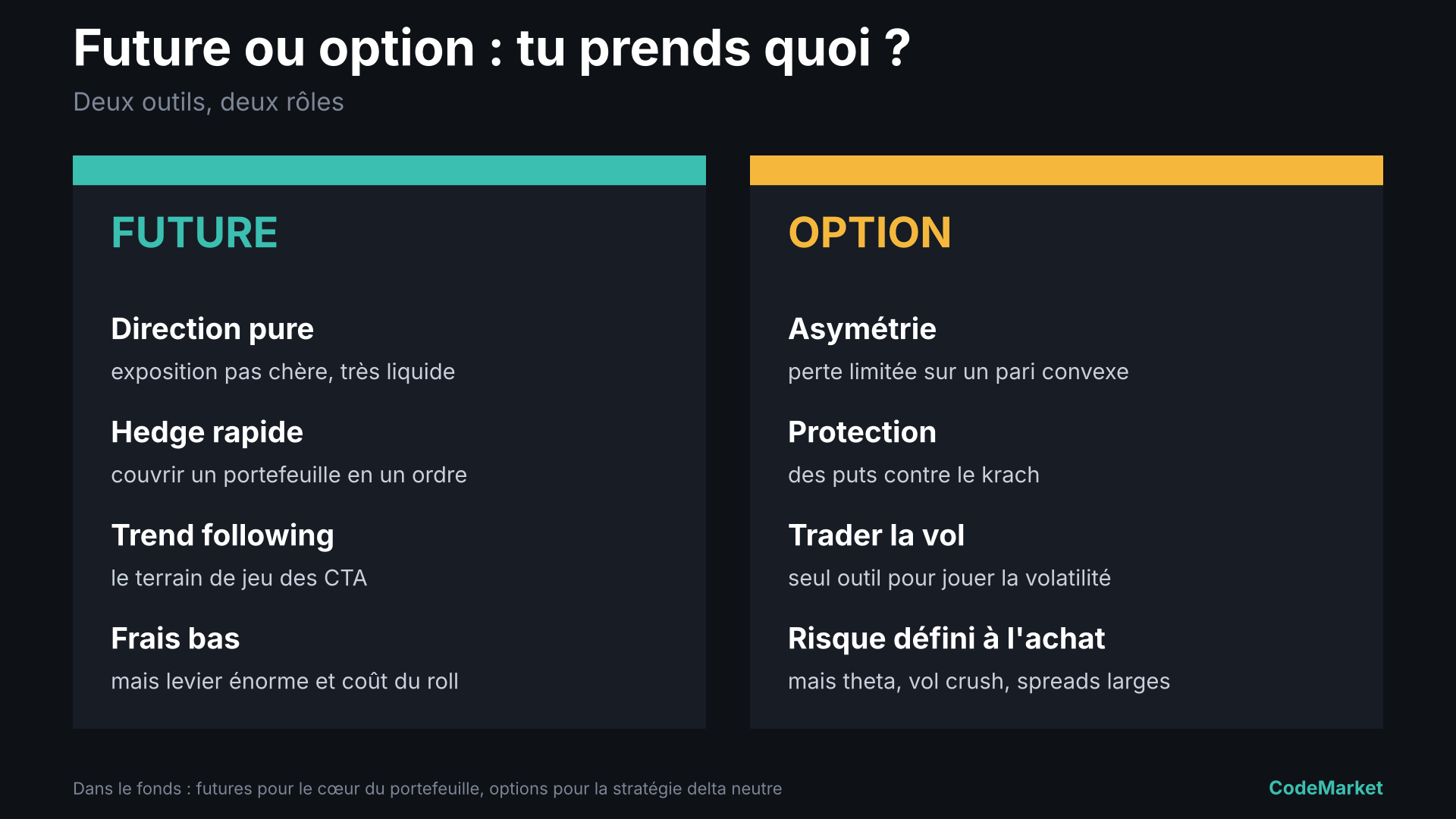
If you want to bet on the direction of a stock index, a commodity, a currency or rates, there is no debate: the instrument is the future. Fees are low, liquidity is excellent with tight spreads on the major contracts, execution is simple and your P&L is easy to understand. Every purely directional strategy, trend following or simply hedging all or part of a portfolio, belongs on futures.
As soon as your trade is not purely directional, you need options. For example when you have a view on direction and a separate view on volatility, or when you want convexity: protecting a portfolio only below a certain level with puts, rather than neutralizing it completely. A future only lets you play one parameter, the direction.
Future ou option, lequel utiliser : le future pour l'exposition directionnelle, la couverture rapide et le trend following ; l'option pour les paris asymétriques, la protection contre un krach et le trading de volatilité.
In my own portfolio, everything that drives exposure (currencies, commodities, precious metals, oil, US indices, rates) runs on futures. I also use futures for spread trades, for example long Korea against short Japan. Options only come out of the drawer for other strategies: delta neutral arbitrage, volatility and term structure arbitrage on indices, or premium capture such as the wheel on stocks I hold or want to own. Never for a pure directional bet.
6. The Hidden Costs of Each Instrument
On futures, the main hidden cost is the roll. Contracts expire every one to three months, so to keep a position open you roll it to the next maturity. If the curve is in contango, the carry is negative and every roll costs you money. Long VIX futures as a volatility hedge and long oil are the classic examples where the roll is expensive. The reverse also exists: on some currency pairs, being long or short the future earns you money at every roll, which is the basis of carry trades. On bonds, if the overnight rate is below the 10 year yield, being long the 10 year future earns carry at each roll, and the opposite when the curve is inverted.
On options, you already pay theta every day. Then comes the volatility crush: if implied volatility drops sharply while you are long options, they can lose most of their value even if the underlying moves your way. And there is liquidity: on single stocks, option markets are often thin with wide bid ask spreads. If you are in a hurry and cross the spread on every entry and exit, the cost adds up fast.
7. Backtesting Futures vs Options
If you trade systematically like I do, there is one more difference. Backtesting a strategy on futures is relatively simple: clean price series, low costs, linear P&L. Backtesting options is much harder, both in terms of data and in modeling the spreads you will really pay.
If you backtest an options strategy, penalize every trade with high transaction costs to make sure your results are realistic. A backtest that ignores option spreads is not optimistic, it is wrong. In the next video, I present three futures strategies used by the largest hedge funds in the world.
Are options less risky than futures?
Only when you buy them. A long option caps your loss at the premium paid. A short option collects a small premium but exposes you to large losses and margin calls if the market moves against you, which can make it riskier than a future.
How much capital do I need to trade a future?
You do not pay the full contract value, you post margin, often around 10% of the contract value depending on the product and broker. But your exposure is the full notional, and losses are settled in cash every day, so you need a cash buffer to absorb margin calls.
Why does my option lose value when the stock goes in my direction?
Because an option price also depends on time and implied volatility. If the move is too small or too slow, theta eats the gain, and if implied volatility drops (for example after earnings), the vol crush can outweigh the move in the underlying.
Which instrument should I use to hedge my portfolio?
Selling futures neutralizes your exposure quickly and cheaply, but you also give up the upside. Buying puts protects you below a chosen level while keeping the upside, at the cost of a premium. The right choice depends on what you want to keep and how much you are willing to pay.
What is the roll cost on futures?
Futures expire, so keeping a position means closing the expiring contract and opening the next one. In contango, the next contract is more expensive, so a long position loses value at every roll. On VIX and oil futures this cost can wipe out a large part of the performance.